




- Oceana County -
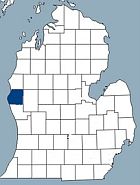 Oceana county is located in the west-central part of Michigan. The surrounding counties are Mason (north), Newaygo (east), Muskegon (south), and Lake Michigan forms the
western boundary. Oceana county was laid out in 1831 from Michilimackinac county, when Michigan was still a territory, but was much more extensive than it it today.
At the time it contained parts of what are now Muskegon, Kent, Newaygo, Montcalm and Mecosta counties.
It remained "laid out" without settlers until 1840, when it was attached to Ottawa county for judicial and municipal purposes. On February 13, 1855, by Act 171
of the session of 1855, the three counties of Oceana, Mason and Manistee were organized.
Oceana county is located in the west-central part of Michigan. The surrounding counties are Mason (north), Newaygo (east), Muskegon (south), and Lake Michigan forms the
western boundary. Oceana county was laid out in 1831 from Michilimackinac county, when Michigan was still a territory, but was much more extensive than it it today.
At the time it contained parts of what are now Muskegon, Kent, Newaygo, Montcalm and Mecosta counties.
It remained "laid out" without settlers until 1840, when it was attached to Ottawa county for judicial and municipal purposes. On February 13, 1855, by Act 171
of the session of 1855, the three counties of Oceana, Mason and Manistee were organized.
The economy of Oceana county was originally built on the lumber trade. Logs were floated down river to the mills where they would be cut and loaded aboard "lumber hookers" destined for larger cities such as Chicago. Pentwater was then a bustling lumber town. with a planing mill, two shingle mills, a barrel-stave mill, and three sawmills. The largest, and last, of these mills was the Sands and Maxwell mill which was destroyed by fire in 1884. After the lumber industry died the county turned to agriculture and today it is famously known as the "Asparagus Capital of the World."
 In the early days, before the railroads came, the only means of shipping or receiving supplies was by ship and where
there are ships there are, inevitably, shipwrecks. The twenty mile stretch between Little Point Sable and Big Point Sable was quite
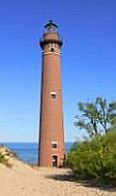
treacherous. In 1871 Congress approved funding for "Petite Pointe Au Sable Lighthouse" to mark the dangerous point. Due to a lack of roads construction couldn't commence
until 1874. Standing 107 feet high, the bright third-order Fresnel lens can be seen for 15 nautical miles.
In the early days, before the railroads came, the only means of shipping or receiving supplies was by ship and where
there are ships there are, inevitably, shipwrecks. The twenty mile stretch between Little Point Sable and Big Point Sable was quite
treacherous. In 1871 Congress approved funding for "Petite Pointe Au Sable Lighthouse" to mark the dangerous point. Due to a lack of roads construction couldn't commence
until 1874. Standing 107 feet high, the bright third-order Fresnel lens can be seen for 15 nautical miles.
Today there are 17 townships in Oceana county which cover a total of 1,306 sq. miles. The county seat, and largest city, is Hart.