
- Davidson County -
Confederate Soldiers' Home
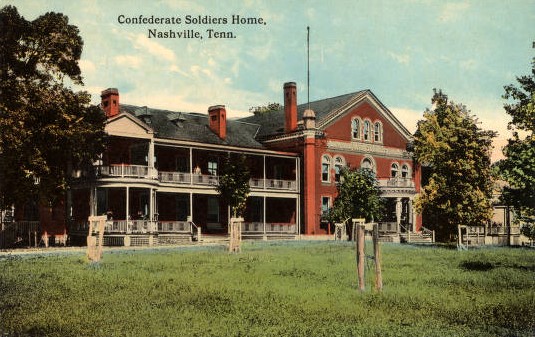
- By act approved April 4, 1889, "The Hermitage" - General Andrew Jackson's farm,
owned by the State, situated twelve miles east of Nashville, on the Nashville and Lebanon Turnpike,
and consisting of about five hundred acres of land, except the mansion house and twenty-five acres,
which were conveyed to the Ladies' Hermitage Association - was conveyed in trust for the term of
twenty-five years to a board of nine trustees, to be appointed by the Governor upon the recommendation
of the Association of Confederate Soldiers, Tennessee Division, for the purpose alone of providing homes
for indigent and disabled soldiers who volunteered in the service of the Confederate States, their widows
and orphan children, prorated among the various congressional districts of the State according to their
population. Ten thousand dollars were appropriated by the State for the purpose of placing the farm in
proper condition, to be so managed as to make the farm as near self-sustaining as possible, and the
establishment of such industries as may be adapted to the capabilities of the beneficiaries. By the
terms of the act establishing same, the Board of Trustees are to be selected as follows: Two from East
Tennessee, two from West Tennessee, and five from Middle Tennessee. They serve without compensation;
elect a President and Secretary, resident in Nashville, and Manager for the farm, and look after the
welfare and comfort of the beneficiaries. The officers are Mark S. Cockrill, President; P. P. Pickard,
Treasurer; T. H. Maney, Secretary. -
source: The Official and Political Manual
of the State of Tennessee
pub: Marshall and Bruce, Stationers, Nashville, TN - 1890
The Tennessee Confederate Soldiers' Home opened in 1892 on the grounds of the Hermitage Plantation, former residence of Andrew Jackson. It provided care and housing for aging Confederate veterans who lived in Tennessee. When the home closed on November 22, 1933, the six veterans who were still living there were moved to the Girls Infirmary at the Tennessee Industrial School. The building was demolished by 1936 and its bricks were used to build a gift shop at the Hermitage. The last inmate of the home died in 1941. Many of the soldiers who occupied the home are buried in a cemetery on the Hermitage grounds about a mile away from the old home.