

South Dakota (temporary) Archivist :
- South Dakota Fast Facts -
 In 1803, the United States purchased the Louisiana Territory (see U.S. state/territory progression here) from Napoleon Bonapart, The Purchase included all but a small portion
of land in the northeastern corner of what is now South Dakota. The Lewis and Clark Expedition,also known as the Corps of Discovery,
was organized by President Thomas Jefferson shortly after and, in 1804, set out to explore the newly acquired territory.
Their route would traverse the (later) Dakota Territory twice. In 1817, an American fur-trading post was set up at the present
day site of Fort Pierre which began the continuous American settlement of the area. The U.S. Army bought Fort Pierre in 1855
but abandoned it two years later in favor of Fort Randall. By this time settlement by American and Europeans was rapidly
increasing. In 1858 the Yankton Sioux signed the 1850 Treaty which ceded most of the present-day eastern South Dakota to
the United States.
In 1803, the United States purchased the Louisiana Territory (see U.S. state/territory progression here) from Napoleon Bonapart, The Purchase included all but a small portion
of land in the northeastern corner of what is now South Dakota. The Lewis and Clark Expedition,also known as the Corps of Discovery,
was organized by President Thomas Jefferson shortly after and, in 1804, set out to explore the newly acquired territory.
Their route would traverse the (later) Dakota Territory twice. In 1817, an American fur-trading post was set up at the present
day site of Fort Pierre which began the continuous American settlement of the area. The U.S. Army bought Fort Pierre in 1855
but abandoned it two years later in favor of Fort Randall. By this time settlement by American and Europeans was rapidly
increasing. In 1858 the Yankton Sioux signed the 1850 Treaty which ceded most of the present-day eastern South Dakota to
the United States.
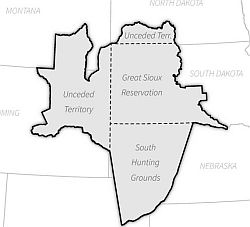 In 1868 a treaty was signed with the Sioux at Fort Laramie which created the Great Sioux Reservataion. This newly formed reservation
included all of the western portion of present day South Dakota. The treaty was broken when, in 1874, gold was discoverd in the
Black Hills during a military expedition led by George Armstrong Custer. War broke out when the Sioux refused to grant mining rights
and the U.S. Government failed to stop miners from entering the Black Hills, long considered a sacred place by American Indian tribes.
In 1868 a treaty was signed with the Sioux at Fort Laramie which created the Great Sioux Reservataion. This newly formed reservation
included all of the western portion of present day South Dakota. The treaty was broken when, in 1874, gold was discoverd in the
Black Hills during a military expedition led by George Armstrong Custer. War broke out when the Sioux refused to grant mining rights
and the U.S. Government failed to stop miners from entering the Black Hills, long considered a sacred place by American Indian tribes.
Dakota Territory was created from Nebraska and unorganized territories on March 2, 1861 and consisted of all the northernmost part of the land acquired in the 1803 Louisiana Purchase and the southernmost portion of Rupert's Land, acquired in 1818. On March 4, 1863 a portion was taken off to form Idaha Territory, with a portion of that being returned in 1864. Wyoming Territory was split off in 1868. The population of Dakota Territory was growing, but the southern portion was more heavily populated which caused residents to demand a separation. South Dakota was admitted to the Union as the 40th state on November 2, 1889.
Today South Dakota covers 77,116 sq. miles, has 66 counties and ranks 46th in population. The capital city is Pierre, and the largest city is Sioux Falls.
The genealogical records held here are for use by the general public. These records have been submitted to the USGenNet Data Repository by volunteers and researchers just like you for permanent on-line free-access.