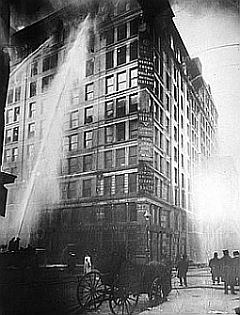
 - The Triangle Shirtwaist Factory Fire -
One of the deadliest industrial disasters in U.S. history occurred in the Greenwich Village neighborhood of Manhatten
at about 4:40 p.m., Saturday, March 25, 1911, when the Triangle Shirtwaist Factory, located on the 8th, 9th and 10th floors
of the ASCH building (northwest corner of Washington Place and Greene Street,) burned causing the deaths of 146 garment workers.
It was supposed that the fire originated in a scrap bin under a cutting table by a carelessly discarded cigarette butt or match
Most of the victims were young immigrants aged 14 to 23, and mostly women and young girls who were burned or leaped to their
deaths during the conflagration.
ISAAC HARRIS and MAX BLANCK, owners of the Shirtwaist Factory, were indicted on charges of first and second degree
manslaughter caused by condtions that they allegedly knew existed in the factory at the time of the fire. The doors of the factory
were locked so managers could check the women's purses to prevent theft. The foreman who held the key escaped, leaving the workers
trapped. There were not enough fire escapes and, those that did exist were so poorly constructed as to make it impossible for any
number of people to descend at one time. The staircases were too narrow to allow for any rapid escape in case of an emergency.
Fire drills were never ordered and there was no equipment to knock down any small fires that might ignite. The factory normally
employed about 500 workers, too many per square foot of floor space.
The trial of HARRIS and BLANCK begain on December 4, 1911. Within two weeks they were both acquitted of all
charges, the jury finding that the prosectution had failed to prove that they had knowledge of the conditions that existed in
their factory at the time of the fire. On September 26, 1913, MAX BLANCK was convicted in the Court of Special Sessions in
Manhattan, of locking the three exits of his new factory where 150 girls were employed. He was fined the minimum of $20. In December,
1913, JOSEPH J. ASCH, owner of the ASCH building which housed the factory, settled nine suits brought by families of Shirtwaist
Fire, for $75 each. Likewise, BLANCK and HARRIS lost a subsequent civil suit brought against them by the victim's families and
were forced to pay $75 for each deceased victim.
Because of the tragedy the Legislature established the Factory Investigating Commission. Their work resulted
in thirty-six new state laws addressing working conditions, safety and health requirements as well as other aspects of code
enforcement.
The Asch building was built in 1901 and still stands today. It was renamed the Brown Building after being
purchased by philantropist Frederick Brown who donated it to New York University in 1929. It was designated as a national historic
landmark by the National Park Service in 1991. In 2002 the building was incorporated into the Silver Center for Arts and Science.