
- Becker County -
Biographies
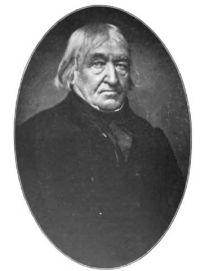 WILLIAM MORRISON - One of Becker County's earliest white settlers, was born in Montreal, Canada, March 7th, 1785
His father was a Scotch immigrant named Allan Morrison, a native of Stornoway, on the Lewis, one of the Hebrides or western Isles, forming part of Scotland, and his mother a Canadian French lady named Jane (or Jessie) Wadin.
William having received a common school education, commenced clerking in a store in Montreal before he was fifteen years of age.
Montreal was at that time the home and general headquarters of the British and Canadian fur traders, who came down the Ottawa and St. Lawrence Rivers, in mackinaw boats and birch-bark canoes, every summer, with their winter's collection of furs, and returned the same season, to the far Northwest, with a new supply of goods for the next winter's business.
The few avenues to fortunes presented to the ambitious young men by the Canada of that day, coupled with the tales of adventures, and stories of the large profits made in the fur trade, fired young Morrison's ambition, and he at the early age of sixteen, was apprenticed by his father with the Northwest Fur Company, then the great rival of the more ancient Hudson's Bay Company, and started for old Grand Portage on Lake Superior, the Company's western headquarters, with the returning boats.
The next year, in 1802, he was sent to Leech Lake and thence to an outpost on the headquarters on one of the streams tributary to the Crow Wing River, from which point they collected furs from their Indian hunters scattered through what is now Becker and Otter Tail Counties. These Indians were Pillager, Chippewas, and from information gathered from some of the old Indians I knew at Leech Lake in 1870, and who remembered well "Sha-gah-nansh-eence," the "Little Englishman," as he was called by the Chippewas, I would locate this outpost at Shell Lake.
In 1803-4 Morrison wintered at Upper Rice Lake on the headwaters of the Wild Rice River, and it was during that winter and in the spring of 1804 that he visited Lake Itasca and the various smaller lakes which form part of the source of the Mississippi River. No white man had ever visited that country before Morrison, and he rightfully claimed to be the discoverer of the source of this great river, although Nicollet, Beltrami and Schoolcraft all claimed this honor several years later.
It being the policy of the Northwest Fur Company not to allow any of its traders to remain more than one or two years at the same outpost, Morrison was, in this manner, enabled to visit many places, and became well acquainted with the fur resources of a vast territory: the knowledge so acquired soon proved of great value to him.
His industrious habits and natural shrewdness, coupled with his ability to handle the rought "voyageurs" and his popularity among the Indians, soon attracted the notice of his employers, and after several years spent in managing various trading posts in Minnesota, he was placed in charge of a number of them, with headquarters at Sandy Lake, on the upper Misissippi River. It was while stationed there that an incident occurred, illustrating his popularity with, and influence over the Indians.
Tecumseh's brother, "The Prophet," had sent out his tobacco to all the western and northwestern tribes, with a secret message to the Indians to join him in a general massacre of the whites in the Indian country.
Such was the reputation and influence of this famour grand medicine man, the prophet, over the Indians, that although the Chippewas were of a peaceful disposition and had no great cause of complaint against their traders, they dared not refuse the invitation. The tobacco sent was smoked in secret council, the Indians withdrew away from the trading posts, and generally assumed an unfriendly attitude.
Morrison had left Sandy Lake and gone on a business trip to Fond du Lac, to meet with the other chief traders and the managing board of the Northwest Company. While there, messengers came in from Sandy Lake and a number of other trading posts, with reports, that the Indians were acting in an unfriendly manner, and that their actions indicated there was mischief brewing, but none of the traders' employes could find out what the trouble was.
The assembled traders decided that Morrison was the only one able to get the secret out of the Indians, and he started at once for Sandy Lake, his own post, with the messenger who had brought the report. They had a light birch canoe and traveled rapidly, so that on the forenoon of the third day they paddled out of Prairie River into Sandy Lake.
Some young Indians, who were returning from a deer hunt, recognizing him, hurried home to spread the news, that the "Little Englishman" was coming home. From stray hints heard while at Fond du Lac, Morrison had made up his mind that "The Prophet" was at the bottom of the trouble, and he soon decided on his plan of action. Paddling close to the shore he was soon opposite the wigwams of the Indians, but contrary to custom he never stopped to enquire about the news and kept on as if in a great hurry. This nettled the suspicious Indians, and one of them was sent on to intercept Morrison above one of the small portages which cut across the points formed by the long bends of the Mississippi River, below the mouth of the Sandy Lake River. His face was painted black, and as Morrison did not seem to notice him, the Indian hailed the canoe, when the paddlers stopped. "You seem to be in great hurry," said the Indian, "what news where you come from?" "Nothing," answered Morrison, "and what is going on here?" "Nothing here either." Then Morrison began slowly paddling away; stopping suddenly, he half turned around saying: "Oh, yes, there is some news I was forgetting. The great medicine man, "The Prophet," has been killed by the Long Knives, (the Americans). Then he resumed paddling and soon reached his stockade, a short distance down the Mississippi. The next day the Indians flocked in and resumed friendly relations, without showing the least sign of ill feeling.
As luck would have it, messengers came a few days afterwards from Lake Superior, confirming his report of the death of "The Prophet," and all circumstances connected with the plot came out.
It was a lucky hit. Morrison had calculated that if he could get the Indians to come around, he would succeed in getting them started out deer hunting, birch-bark raising, etc., and get them scattered, so they could not spend their days of idleness in plotting more mischief.
William Morrison stayed with the Northwest Fur Compnay until in 1816, when being offered better inducements, he joined the American Fur Company (John Jacob Astor's), and was placed in charge of the department of Fond du Lac, with headquarters at Old Superior, Wisconsin. This department embracing within its territory, Lake Vermillion, Red Lake, Sandy Lake, Leech Lake, Lake Winnebagoshish, Cass Lake, Otter Tail Lake, Crow Wing on the Mississippi, and Grand Portage on Lake Superior. He remained in charge of John Jacob Astor's business there until 1826, when having acquired what was called a competency for those days, he retired from the fur trade and returned to Canada. There he purchased a large island, since known as Morrison's Island, in the St. Lawrence River, between Old Fort William Henry, now Sorel, on the south shore, and Berthier-en-Haut, on the north shore of the river.
For some years he was engaged in farming, but pastoral life was too quiet and unexciting for his active mind, and after a few years spent on the farm, he settled in Bertheir, where for many years he carried on a mercantile business, and was also judge of the county court.
While trading in the upper Mississippi country, he married a Pillager Chippewa woman, by whom he had two boys and a girl. His wife dying soon after the birth of the last born, the children were, according to Indian custom, taken care of by the wife's mother, who always thereafter followed and lived with her grandchildren. When Morrison left the Indian country in 1826, he made arrangements to take his three children with him, but on the eve of the day set for the departure of the boats, from Superior for Mackinoe, the grandmother stole the children and disappeared during the night. Search for them was made for several days, but without success, and they were necessarily left behind. They returned eventually to Leech Lake, and in course of time the two boys grew to be great hunters and warriors, and many Sioux scalps dangled from their belts whenever they went out with a war party.
In spite of their Indian bringing up, and thanks to the good advice given them by their uncle, Allan Morrison, they never forgot that they were of white blood, and always exercised their influence over their reckless tribesmen to keep them from molesting the whites, and but for the stand taken by Joseph, (or Ay-gans as the Indians called him), at Leech Lake during the outbreak of 1862, there would have been a massacre of the employes and traders at the agency.
Hole-in-the-day, head chief of the Mississippi Chippewas, had stirred up the Pillagers to such a pitch that they had robbed the stores and made the whites prisoners. They had met in several councils and the most reckless of them had decided that the whites must die the next morning. Ay-gans had taken an active part in the councils, but had always taken the part of the prisoners. At last, when he saw that all his efforts had been in vain, he got up and spoke about their commradeship in war and in the hunts, and also on their relationship to one another and of that law of nature which binds kin to kin, and then he bared his arm, displaying his light skin, saying: "You are talking of killing our white friends, and you say they must die tomorrow. Look at this arm; it is light colored, the blood that runs through it is white man's blood, and when you kill our white friends you will kill me also." That last part of the speech was telling. Ay-gans was a brave man, and his last words, were to Indian ears, both defiant and threatening. The next morning other brave men took sides with the whites and their lives were spared. They were marched down to Gull Lake as prisoners, and turned over to the care of the Gull Lake Indians, and afterwards liberated.
Descendants of this Jos. Morrison are now settled on the Wild Rice River in Norman County, but formerly were a part of the first contingent of Otter Tail Chippewas, who removed with their father to Becker County in 1872, and settled around the present agency and the Old Trading Post.
The daughter was taken into the family of one of the missionaries and followed them to Stillwater, where she married a German farmer, and died several years ago. Joseph died at Beaulieu, Minn., in January, 1889. His older brother Richard, or Dekaince, died at Otter Tail Lake about 1870.
William Morrison's second wife was a Miss Ronssain, daughter of a Fond du Lac, Minn., Indian trader. She was the mother of two sons and two daughters, and went with her husband to Canada, where she died a few years afterwards. William, the oldest of the two boys, left Canada for the west and eventually joining one of Col. Fremont's expeditions to the Pacific coast, went to California, where he settled and died about 1850.
The younger son, Donald George, left Canada before he was twenty years of age, and worked his way through Michigan, Illinois and Wisconsin to Minnesota, where he settled in the Red River valley near the boundary line, and became a member of the Territorial Legislature of Minnesota. A few years later he settled in Old Superior, Wisconsin, where he was elected register of deeds of Douglas County, an office he held for years afterwards. He died in Superior, in 1898.
After the death of his second wife, William Morrison found himself with four young children, with none but hired help to manage and care for them, so after a couple years of this kind of existence, he married Miss Elizabeth Ann Kittson, an elder sister of the late Commodore N. W. Kittson of St. Paul, Minnesota. Four daughters were born of that union.
Mrs. Morrison died in February, 1864, and her husband, who had been blind for several years, could not bear up long under the blow. He aged rapidly after this, and although surrounded by kind friends who endeavored by their attentions and company, to keep his mind interested in the events of the day, he lost all interest in life and gradually passed away. He died on Morrison's Island August 7th, 1866, and was buried in Sorel, alongside of his last wife.
In religion he was an Episcopalian, and in politics a Conservative, and a strong supporter of the Canadian government in the troublesome years of 1837-38, and possessed of much influence with the authorities. This he used to good advantage after the rebellion, and was instrumental in saving the lives and liberty of many of his patriotic friends.
The accompanying portait was teken when he was about sixty-nine years of age.
Source: A Pioneer History of Becker County
by Mrs. Jessie C. West
pub. 1907, Pioneer Press Co., St. Paul, MN
- Home |
- MN Data Repository |
- Becker County |
- About |

Support Free-access Online History and Genealogy.
Support USGenNet!
Today is Tuesday, 09-Jun-2026 08:02:12 UTC
© USGenNet Inc., 2004 - 2026, All Rights Reserved