- Keweenaw County -
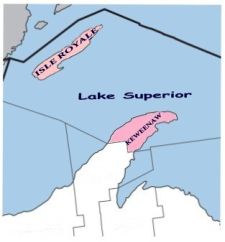 Situated at the tip of the Keweenaw Peninsula, Keweenaw County
is the northernmost county in Michigan and includes Isle Royale, 56 miles to the northwest, and Manitou Island off the northeastern tip. (This island should
not be confused with North Manitou and South Manitou Island which are in Lake Michigan.)
Isle Royale is the largest natural island in Lake Superior, and 2nd largest island on the Great Lakes.
Isle Royale was detached from Keweenaw county in 1875 and organized into a separate county. The county of Isle Royale was dissolved in 1897 and the island again became a part of
Keweenaw County. Today Isle Royale and the numerous smaller islands surrounding it comprise Isle Royale National Park.
Situated at the tip of the Keweenaw Peninsula, Keweenaw County
is the northernmost county in Michigan and includes Isle Royale, 56 miles to the northwest, and Manitou Island off the northeastern tip. (This island should
not be confused with North Manitou and South Manitou Island which are in Lake Michigan.)
Isle Royale is the largest natural island in Lake Superior, and 2nd largest island on the Great Lakes.
Isle Royale was detached from Keweenaw county in 1875 and organized into a separate county. The county of Isle Royale was dissolved in 1897 and the island again became a part of
Keweenaw County. Today Isle Royale and the numerous smaller islands surrounding it comprise Isle Royale National Park.
Sometimes called "Copper Island," Keweenaw County is separated from the rest of the peninsula by the Keweenaw Waterway which spans the
peninsula between the cities of Houghton and Hancock. Having a total area of over 5,900 square miles it is technically the largest county in Michigan however only 540 square miles is land.
In 1840 Douglass Houghton published his report describing the copper deposits found on the Keweenaw Peninsula. A land rush would soon follow as miners and investors flocked to
the area. The Cliff Mine, located south of Eagle River, began production in 1845 and was the first large-scale mine on the Keweenaw Peninsula. The mine closed in 1870 but not until it had rewarded
its investors with over $2.5 million in returns. Artifacts made from Lake Superior copper have been found in archealogical digs across the nation.
Keweenaw County was set off from Houghton County on March 11, 1861. The county seat and most populated community is Eagle River.